
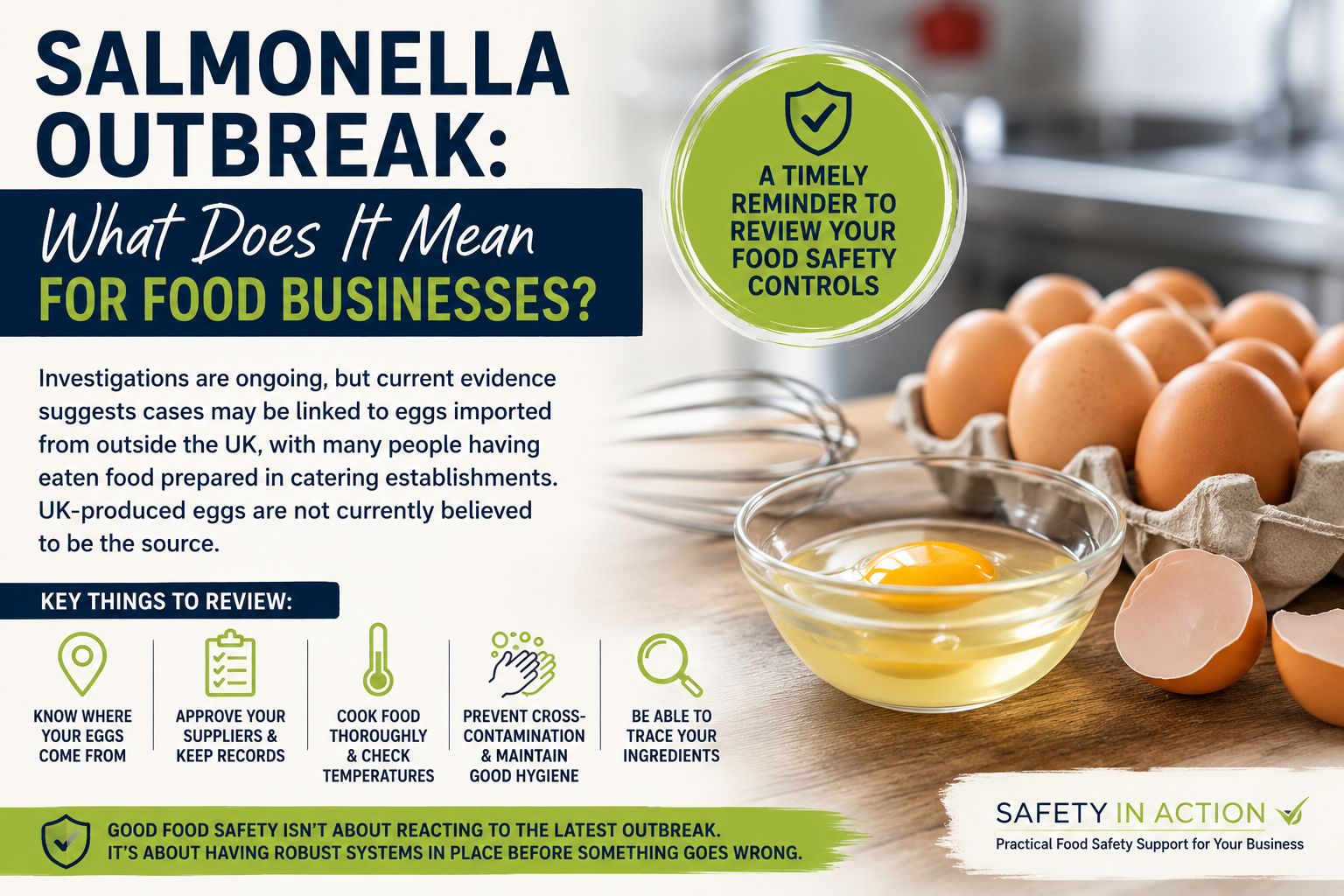
Salmonella Outbreak: What Does It Mean for Food Businesses?
The recent news about a Salmonella outbreak in the UK has understandably raised concerns among consumers – particularly when eggs and food served in restaurants and cafés are involved.
So, what do food businesses need to know?
At the latest count, more than 200 people have been affected by the outbreak, with one person sadly dying and a significant number requiring hospital treatment. Investigations by the UK Health Security Agency (UKHSA) and Food Standards Agency (FSA) indicate that cases may be linked to eggs imported from outside the UK, with many of the affected people having eaten food prepared outside the home.
Does this mean eggs are unsafe?
No – and this is an important distinction.
The investigation has not identified UK-produced eggs as the source of the outbreak. The evidence currently points towards imported eggs, which are understood to have been used mainly in food service and catering.
The UK has strong controls around Salmonella in domestic egg production, including vaccination requirements for laying hens supplying the UK market.
However, the outbreak is a useful reminder that food safety doesn’t stop at the point where ingredients arrive in your kitchen.
What should food businesses be thinking about?
If you run a café, restaurant, hotel, takeaway or other food business, now is a good time to revisit your egg controls.
1. Know where your eggs come from
Do you know whether the eggs you purchase are UK-produced?
Don’t simply assume that because you buy them from a UK wholesaler, they were produced in the UK.
Your supplier should be able to provide information about the origin of the eggs and you should have appropriate supplier approval and traceability arrangements in place.
2. Think about how eggs are being used
Eggs can be incorporated into many foods where they may not subsequently receive a thorough cooking step.
For example:
- Mayonnaise and other sauces
- Hollandaise
- Desserts
- Mousses
- Tiramisu
- Cakes and batters
- Soft or runny eggs
- Egg-based fillings
This doesn’t mean that all of these foods are unsafe. It means that businesses need to understand the risks associated with the particular ingredients they use and the processes they follow.
3. Consider your vulnerable customers
Children under five, older people, pregnant women and people with certain underlying health conditions can be more vulnerable to serious foodborne illness.
The FSA has advised vulnerable groups to avoid raw or undercooked egg dishes when eating out while the current outbreak is being investigated.
For food businesses, this is a reminder to make sure staff understand how to respond when customers ask questions about ingredients, cooking methods or food safety.
4. Check your cooking procedures
Cooking is one of the important controls for reducing the risk from Salmonella.
Are your staff clear about your cooking requirements?
Are temperatures being checked where appropriate?
Are cooking procedures documented and followed consistently?
And, perhaps most importantly, are staff actually following the procedures when the kitchen gets busy?
A food safety procedure is only useful if it works in practice.
5. Don’t forget cross-contamination
Salmonella isn’t only about cooking.
Good hand hygiene, preventing cross-contamination, cleaning and disinfection, safe storage and effective separation of raw and ready-to-eat foods all form part of your food safety controls.
And remember that food handlers themselves can also spread infection.
Anyone suffering from diarrhoea or vomiting should not be preparing food for others and should follow the appropriate exclusion procedures.
What about British Lion eggs?
You may have seen references in the news to the British Lion mark.
The British Lion scheme provides additional assurance around the production of UK eggs and Salmonella controls. However, businesses shouldn’t rely on a logo alone as their entire food safety system.
You still need appropriate supplier controls, storage, handling, cooking and hygiene procedures.
This outbreak is a reminder – not a reason to panic
Food safety incidents can sometimes lead to headlines suggesting that a particular food is suddenly “unsafe”.
The reality is usually more complicated.
The current investigation is still developing, and the authorities have not suggested that consumers should stop eating eggs altogether.
For food businesses, the most useful response isn’t panic.
It’s review.
Ask yourself:
Do I know where my ingredients come from?
Do I have effective supplier approval and traceability?
Are my food safety procedures appropriate for the foods I produce?
Are staff following those procedures consistently?
And if you haven’t reviewed your food safety management system recently, perhaps this is a good time to do it.
Good food safety isn’t about reacting to the latest outbreak.
It’s about having robust systems in place before something goes wrong.
Read more about the outbreak here.
Safety in Action helps food businesses with food safety documentation, training, consultations and practical advice. If you’re concerned about your food safety procedures or would like an expert to review them, get in touch.
Blog and image created with the help of AI.